
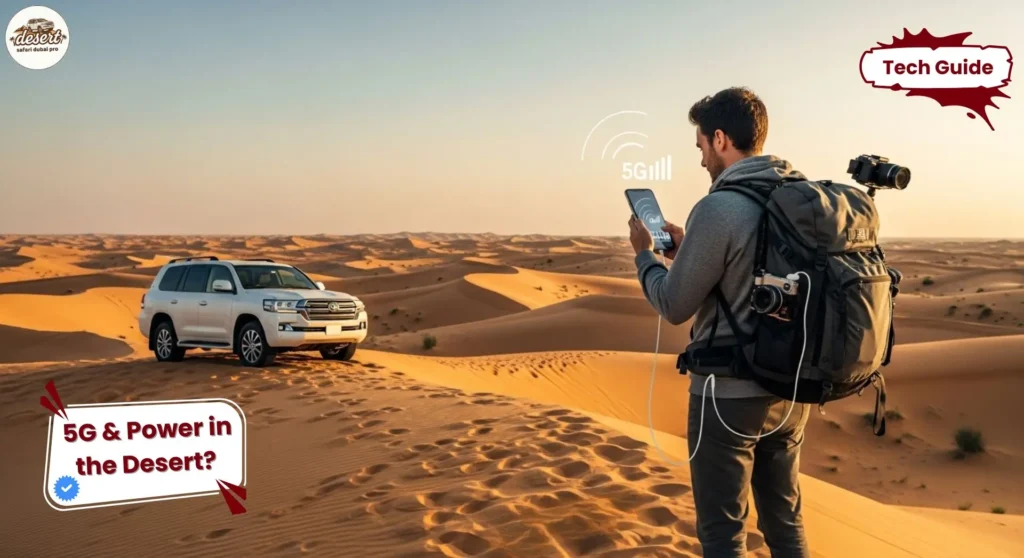
Staying Online While You Go Off-Road
You’re racing over dunes, capturing cinematic clips, uploading Stories, and navigating a new landscape—all at once. Welcome to the reality of a tech-first desert safari in 2026.
But here’s the catch: the Dubai desert is not a city. Connectivity fluctuates, devices overheat, and batteries drain fast. If you’re planning content creation, remote work, or even basic navigation, you need a strategy.
This guide is built for modern travellers—creators, digital nomads, and anyone who wants reliable 5G in Dubai desert, strong power backup, and smart gear management. We’ll break down networks, heat control, power solutions, and legal rules so you can stay connected without ruining your devices.
The Network Battle – Etisalat vs Du in the Desert
Understanding Internet Coverage in Lahbab
The red dunes of Lahbab are stunning—but connectivity there is inconsistent.
- Near highways / entry points: Strong 4G/5G
- Mid-desert (deep dunes): Patchy signal
- Remote areas: Possible signal drops
👉 If you’re planning your route, read our guide on choosing the right desert (red vs golden dunes) to understand how location impacts coverage.
Etisalat vs Du – Real-World Comparison
Let’s get practical.
Etisalat (e& UAE)
- Generally stronger rural infrastructure
- More stable signal in deeper desert areas
- Better fallback to 4G when 5G drops
Du
- Strong speeds near city outskirts
- Slightly weaker deep-desert penetration
- Good for casual usage, not ideal for remote zones
Verdict for 2026
- Best for deep desert (Lahbab): Etisalat
- Best for city-edge safaris: Du or Etisalat
- For creators / livestreamers: Always carry a dual-SIM setup
Pro Tips for Signal Stability
- Download offline maps before leaving
- Avoid relying on real-time navigation only
- Switch to airplane mode and back to refresh signal
- Use messaging apps that work on low bandwidth
Keeping Your Gear Cool in Extreme Heat
Why Overheating Happens
Desert temperatures can exceed 45–50°C (113–122°F).
When filming or navigating:
- CPU usage increases
- Screen brightness stays high
- Direct sunlight heats the device
Result: Your phone shuts down automatically.
Common Overheating Situations
- Recording 4K/8K video
- Using drones or external apps
- Charging while filming
- Leaving phone exposed on dashboard
How to Prevent Overheating (Essential Tips)
Keep your device alive with these methods:
- Store your phone in shade when not in use
- Avoid charging while recording
- Lower screen brightness manually
- Use airplane mode when possible
- Turn off background apps
Advanced Cooling Tricks (Used by Creators)
- Use thermal phone cases
- Carry a cooling pouch or gel pack
- Place device near AC vents inside vehicle
- Shoot in short bursts instead of continuous recording
Power Solutions – Why Normal Power Banks Fail
The Problem with Standard Power Banks
Most travellers carry basic 10,000 mAh power banks.
In desert conditions:
- Heat reduces battery efficiency
- Charging becomes slower
- Devices consume more power
👉 Result: Your power bank drains faster than expected.
Best Power Bank for Desert Safari (2026 Standards)
Look for:
- 20,000 mAh or higher capacity
- Fast charging (PD / QC support)
- Heat-resistant build
- Multiple output ports
Solar Chargers vs High-Capacity Bricks
Solar Chargers
Pros:
- Renewable energy
- Useful for long trips
Cons:
- Slow charging
- Inefficient in extreme heat
- Not reliable as primary source
High-Capacity Power Banks (Recommended)
Pros:
- Fast charging
- Reliable output
- Works instantly
Cons:
- Needs pre-charging
- Slightly heavier
👉 Best strategy: Carry a high-capacity power bank + optional solar backup.
Power Management Strategy
- Charge all devices before departure
- Keep one device as backup only
- Turn off unused gadgets
- Avoid unnecessary filming
Vlogging in Dubai Desert – Pro Creator Tips
Capturing Stable Footage
Desert terrain is bumpy.
Use:
- Action cameras (GoPro-style)
- Gimbals for smartphones
- Mounts inside vehicles
Best Times to Shoot
- Golden hour (sunset): Best lighting
- Early morning: Soft shadows
- Avoid midday (harsh light + heat)
Audio Challenges
Wind noise is a big issue.
Solutions:
- External microphones
- Wind shields (deadcat covers)
- Voice recording separately
Storage & Backup
- Use high-speed SD cards
- Carry extra storage
- Backup footage during breaks
Photography & Drone Laws in Dubai Desert
Drone Rules You Must Know
Flying drones in Dubai is strictly regulated.
- You must have official registration
- Many desert areas are restricted
- Near highways or military zones = prohibited
Where You Can Fly (With Permission)
- Designated open desert zones
- Approved areas away from city
Where It’s Illegal
- Near airports
- Near residential zones
- Without permit
⚠️ Important: Violations can result in fines or confiscation.
Alternative to Drone Shots
If drones aren’t possible:
- Use wide-angle lenses
- Capture from dune peaks
- Use vehicle-mounted cameras
Smart Packing for Tech Users
Your outfit matters for your gear.
- Choose clothes with secure pockets
- Avoid loose items that fall in sand
- Carry small tech pouches
👉 For full clothing advice, see what to wear for desert safari.
Connectivity vs Experience – Finding Balance
Here’s the reality.
You can:
- Stay connected
- Capture content
- Share live moments
But don’t forget:
The desert is also about:
- Silence
- Nature
- Escape from screens
Be Smart, Stay Powered
A tech-savvy safari in 2026 is absolutely possible—but only if you plan ahead.
Remember:
- Choose the right network (Etisalat preferred)
- Protect your devices from heat
- Carry powerful charging solutions
- Follow drone laws
Conclusion + CTA
Technology can enhance your desert experience—but only when used wisely.
Balance filming with enjoying the moment. Capture memories—but also live them.
👉 Want a smoother experience with charging options, stable stops, and better connectivity? Book a tech-friendly private desert safari now at desertsafaridubaipro.com and travel smart in 2026!